I got a new car shed allotment near my home: eight slots, one entry, pick one. Permanent ownership, no rotation. A decision you make once and live with for years.
Most people walk in, eyeball it, pick whichever feels right. I almost did the same. Then I realized this is a small optimization problem. Reverse-park geometry, exit angles, monsoon wind, daily walk distance, door swing - all knowable, all worth thinking about.
So I asked Claude.
The setup
I sketched the layout in Excalidraw and uploaded it:
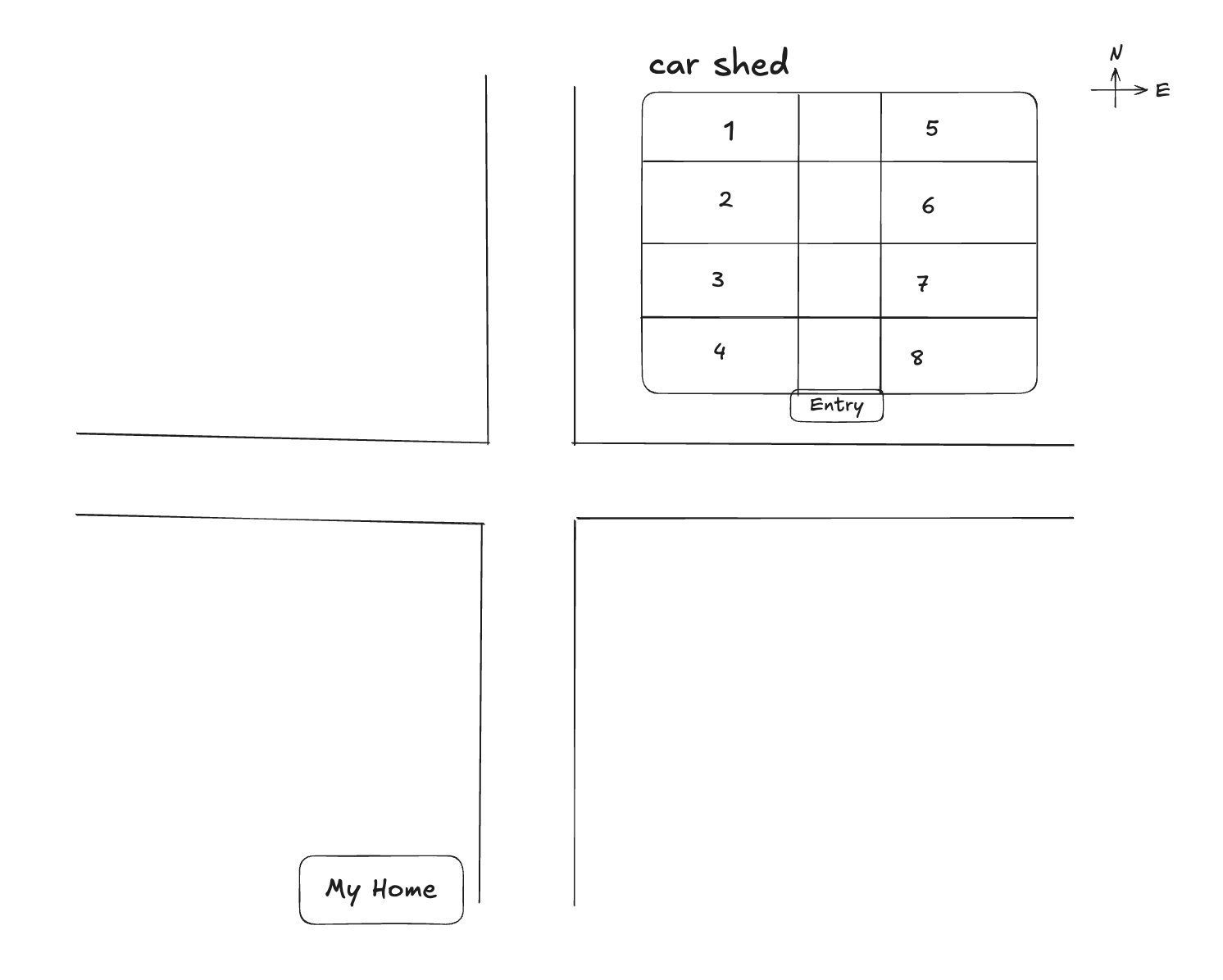
Eight slots, two columns of four. Center column is a single-car-wide drive lane. Entry from the south. My home sits southwest. I drive a Kia Sonet.
My prompt:
Given is the map of my home area, and I have a car, and I am planning to park my car in a car shed. The car shed has 8 slots, and there is only one entrance. I need you to get me the optimal car slot position so that it will be easier for me to park my car and take out my car, practically and ergonomically. Think like someone who is a top 1% candidate for a Jane Street interview, and your reasoning should be top-notch.
What surprised me
Claude didn’t answer.
It came back with 13 clarifying questions: layout, slot orientation, entry width, ownership permanence, usage frequency, parking style, driver setup, roof gaps, prevailing wind, neighbor cars, lighting, and whether the home marker on my map was actually my home.
This is the part most people miss about working with AI. Answer quality scales with context. A one-shot “which slot is best” gets a generic answer. Thirteen clarifying questions get a real one.
I answered everything. I reverse-park (the Sonet has a reverse camera, and I dislike backing out toward an open driveway). Daily driver. Salem location, so the NE monsoon matters. Driveway has roof gaps; slots are fully covered. Single driver. Door-ding risk low.
The answer
Claude ranked all eight slots and explained the reasoning:
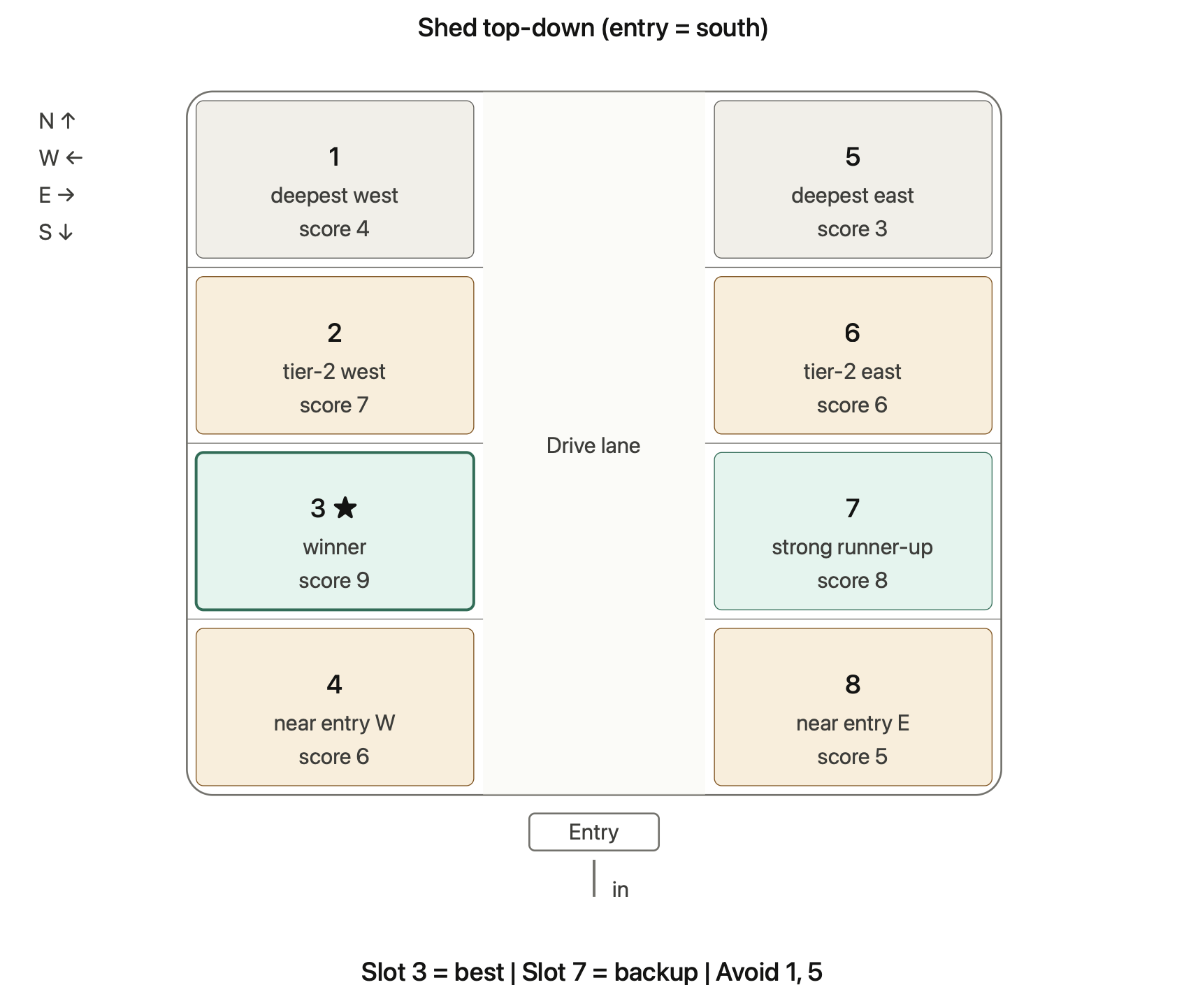
Winner: Slot 3. Backup: Slot 7.
The reasoning hinged on something I hadn’t considered, reverse-park geometry. The drive lane is single-car-wide, so you can’t sweep into a slot. You drive past it, stop, then reverse-arc in. This needs about one car-length of overshoot room past the target slot for a clean single-shot reverse.
- Slot 4 (closest to entry): no overshoot room, you shunt back-and-forth every day
- Slot 1 (deepest): plenty of overshoot, but you waste the full shed length both ways daily
- Slot 3 (tier-2 from entry): overshoot into slot 1’s depth, reverse-arc clean into 3, single shot
Slot 3 is the goldilocks zone: far enough from entry for reverse-arc room, close enough to avoid wasting daily distance.
Then it layered in secondary factors:
- Exit direction. Slot 3 exits with a right turn toward the entry. In a single-lane driveway, right turns sweep wider and easier than left turns. Slot 7 (the east-side mirror) exits with a tighter left turn against the wall.
- Monsoon wind. Salem catches the NE monsoon (October–December). Wind-driven rain blows from the northeast, so east-side slots (5–8) catch more lateral spray through the roof gaps during entry and exit. West-side slots (1–4) sit in the lee.
- One reverse per day. Reverse-park nose-east on entry, and I drive forward out in the morning. This was the real ergonomic win, the hard maneuver happens once a day (evening), and morning rush is forward-only.
The final ranking:
| Rank | Slot | Score |
|---|---|---|
| 1 | Slot 3 | 9/10 |
| 2 | Slot 7 | 8/10 |
| 3 | Slot 2 | 7/10 |
| 4 | Slot 6 | 6/10 |
| 4 | Slot 4 | 6/10 |
| 6 | Slot 8 | 5/10 |
| 7 | Slot 1 | 4/10 |
| 8 | Slot 5 | 3/10 |
What I took away
Three things stuck.
One - AI is good at the boring stuff, not just the impressive stuff. A parking slot isn’t a problem most people frame as worth thinking about. But a wrong choice costs years of small daily friction. Getting it right with AI costs fifteen minutes of conversation. That ratio is hard to beat.
Two - clarifying questions are the actual differentiator. A generic question gets a generic answer. The thirteen questions Claude asked upfront made the analysis specific to my car, my shed, my city, my usage pattern. Treat the first response as a starting point for context, not a final answer.
Three - the reasoning matters more than the answer. Someone at the shed could have told me “slot 3 is good.” But I wouldn’t know why. Now I understand the reverse-park geometry, the right-turn exit advantage, the monsoon-wind angle, the one-reverse-per-day pattern. If my situation changes, with a different car, season, or driver, I know which factors to re-weigh.
The slot was a small decision. The mental model is the keeper.
This post is part of my “AI in action” series, where I document real conversations with AI tools for small, practical decisions.